Download PDF Essential C# 3.0: For .NET Framework 3.5 (2nd Edition), by Mark Michaelis
The Essential C# 3.0: For .NET Framework 3.5 (2nd Edition), By Mark Michaelis tends to be excellent reading book that is easy to understand. This is why this book Essential C# 3.0: For .NET Framework 3.5 (2nd Edition), By Mark Michaelis becomes a favored book to check out. Why do not you really want become one of them? You could delight in checking out Essential C# 3.0: For .NET Framework 3.5 (2nd Edition), By Mark Michaelis while doing other activities. The presence of the soft documents of this book Essential C# 3.0: For .NET Framework 3.5 (2nd Edition), By Mark Michaelis is type of obtaining experience effortlessly. It consists of just how you need to save guide Essential C# 3.0: For .NET Framework 3.5 (2nd Edition), By Mark Michaelis, not in shelves certainly. You may wait in your computer device as well as device.
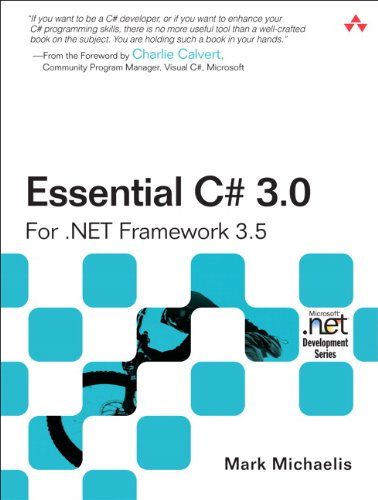
Essential C# 3.0: For .NET Framework 3.5 (2nd Edition), by Mark Michaelis

Download PDF Essential C# 3.0: For .NET Framework 3.5 (2nd Edition), by Mark Michaelis
Just how if your day is started by reviewing a book Essential C# 3.0: For .NET Framework 3.5 (2nd Edition), By Mark Michaelis But, it remains in your gadget? Everybody will always touch and us their device when awakening and also in morning tasks. This is why, we intend you to additionally read a publication Essential C# 3.0: For .NET Framework 3.5 (2nd Edition), By Mark Michaelis If you still perplexed the best ways to obtain guide for your device, you could comply with the means below. As right here, we provide Essential C# 3.0: For .NET Framework 3.5 (2nd Edition), By Mark Michaelis in this website.
This publication Essential C# 3.0: For .NET Framework 3.5 (2nd Edition), By Mark Michaelis is anticipated to be one of the very best vendor book that will make you feel satisfied to buy as well as review it for finished. As known can common, every publication will certainly have specific things that will certainly make someone interested a lot. Even it originates from the author, kind, material, or even the author. Nonetheless, many individuals also take guide Essential C# 3.0: For .NET Framework 3.5 (2nd Edition), By Mark Michaelis based on the motif as well as title that make them surprised in. and also right here, this Essential C# 3.0: For .NET Framework 3.5 (2nd Edition), By Mark Michaelis is quite recommended for you since it has appealing title and motif to check out.
Are you actually a fan of this Essential C# 3.0: For .NET Framework 3.5 (2nd Edition), By Mark Michaelis If that's so, why do not you take this book currently? Be the first person that like and lead this publication Essential C# 3.0: For .NET Framework 3.5 (2nd Edition), By Mark Michaelis, so you could obtain the factor and also messages from this book. Never mind to be perplexed where to obtain it. As the other, we share the connect to go to and also download the soft documents ebook Essential C# 3.0: For .NET Framework 3.5 (2nd Edition), By Mark Michaelis So, you may not bring the published publication Essential C# 3.0: For .NET Framework 3.5 (2nd Edition), By Mark Michaelis anywhere.
The presence of the online book or soft data of the Essential C# 3.0: For .NET Framework 3.5 (2nd Edition), By Mark Michaelis will certainly alleviate individuals to obtain guide. It will additionally conserve even more time to just search the title or author or publisher to get till your publication Essential C# 3.0: For .NET Framework 3.5 (2nd Edition), By Mark Michaelis is revealed. After that, you could visit the web link download to visit that is supplied by this website. So, this will be a very good time to begin appreciating this book Essential C# 3.0: For .NET Framework 3.5 (2nd Edition), By Mark Michaelis to review. Constantly great time with book Essential C# 3.0: For .NET Framework 3.5 (2nd Edition), By Mark Michaelis, constantly good time with money to invest!
Essential C# 3.0 is an extremely well-written and well-organized “no-fluff” guide to C# 3.0, which will appeal to programmers at all levels of experience with C#. This fully updated edition dives deep into the new features that are revolutionizing programming, with brand new chapters covering query expressions, lambda expressions, extension methods, collection interface extensions, standard query operators, and LINQ as a whole.
�
Author Mark Michaelis covers the C# language in depth, and each importantconstruct is illustrated with succinct, relevant code examples. (Complete code examples are available online.) Graphical “mind maps” at the beginning of each chapter show what material is covered and how each topic relates to the whole. Topics intended for beginners and advanced readers are clearly marked.
�
Following an introduction to C#, readers learn about�
- C# primitive data types, value types, reference types, type conversions, and arrays
- Operators and control flow, loops, conditional logic, and sequential programming
- Methods, parameters, exception handling, and structured programming
- Classes, inheritance, structures, interfaces, and object-oriented programming
- Well-formed types, operator overloading, namespaces, and garbage collection
- Generics, collections, custom collections, and iterators
- Delegates and lambda expressions
- Standard query operators and query expressions
- LINQ: language integrated query
- Reflection, attributes, and declarative programming
- Threading, synchronization, and multithreaded patterns
- Interoperability and unsafe code
- The Common Language Infrastructure that underlies C#�
Whether you are just starting out as a programmer, are an experienced developer looking to learn C#, or are a seasoned C# programmer interested in learning the new features of C# 3.0, Essential C# 3.0 gives you just what you need to quickly get up and running writing C# applications.
- Sales Rank: #3104885 in Books
- Published on: 2008-09-01
- Original language: English
- Number of items: 1
- Dimensions: 9.25" h x 1.77" w x 7.00" l, 3.05 pounds
- Binding: Paperback
- 880 pages
Review
Praise for Essential C# 3.0�
�
“If you want to be a C# developer, or if you want to enhance your C# programming skills, there is no more useful tool than a well-crafted book on the subject. You are holding such a book in your hands.”
—From the Foreword by Charlie Calvert, Community Program Manager, Visual C#, Microsoft
�
“In a time when you can search online for any reference material, Essential C# 3.0 is the one book I still bother to carry in my bag. Any developer can hit F1 for help with the language syntax; this book, however, arms me with the knowledge to make better design and coding decisions (and the confidence to say so). You know when a book has more than twenty pages of index that it’s got depth covered, and although Essential C# 3.0 has introductory chapters, it progresses effortlessly into the lesser known corners of the language, which makes this book indispensible to any level of C# developer.”
—Troy Magennis, C# MVP and creator of HookedOnLINQ.com
�
“If you are new to C#, as I was, Mark’s book is an excellent way to start. His approach takes you step by step through the structure and syntax of the language, making it easy to understand how things work. I found the code samples extremely helpful and supportive of the concepts being discussed.”
—Robert Stokesbary, senior consultant, Option Explicit
�
“This book expands on the concepts introduced in Essential C# 2.0 to include C# 3.0 enhancements. One great aspect of this book is that it not only covers the new 3.0 enhancements in great detail, but it also shows where it makes sense to utilize these new features over the existing 2.0 features. While I have been programming C# for many years, I find myself referring to this book often and always seem to find something new buried in the pages. This is a must-read for both the C# newbie as well as the C# seasoned veteran.”
—Michael Stokesbary, senior software engineer, Itron Inc.
�
Praise for the First Edition�
�
“Essential C# 2.0 pulls off a very difficult task. The early chapters are comprehensible by beginning developers, while the later chapters pull no punches and provide the experienced developer with the detailed information they need to make the most of C# 2.0. Starting with the first chapter, Mark has successfully interwoven tidbits of information useful to even the most advanced developer while keeping the book approachable.”
—Chris Kinsman, chief architect, Vertafore, Microsoft Regional Director
�
“How refreshing! This book deals with C# thoroughly, rather than skimming over the whole .NET framework. It is valuable to newcomers and professionals alike.”
—Jon Skeet, C# MVP
�
“Essential C# 2.0 is a one-stop shop for an experienced programmer looking to ramp up on one of the hottest languages around today. Mark delivers an intelligent and detailed tour of C#, providing newcomers to the language with a solid foundation of skill on which to build their next generation of applications.”
—Stephen Toub, technical editor, MSDN Magazine
�
“This book provides complete, up-to-date coverage of all the programming constructs in C#. Masterfully organized, it allows beginning programmers to get on board and leads more experienced programmers into the world of structured programming. Because of its unwavering focus on the essential programming constructs of C#—such as generics, delegates, and much more—this book is indispensable. For programmers who want to solve their day-to-day programming issues using the latest features this modern programming language has to offer, this book is indispensable.”
—Narendra Poflee, IT integration specialist, Itron Inc.
�
“Essential C# 2.0 is an ideal book for all programmers interested in C#. If you are a beginner, you will quickly learn the basics of C# programming and become familiar with the concepts. The flow of the text is easy to follow and does a great job of not repeating concepts that have already been covered. For the experienced programmer, this book has priceless nuggets embedded within its pages, making it a great read for programmers who are already familiar with C#. This will be a book that I will keep next to my computer for years to come.”
—Michael Stokesbary, software engineer, Itron Inc.
About the Author
Mark Michaelis is an enterprise software architect at Itron Inc.�In addition, Mark recently started intelliTechture, a software engineering and consulting company offering high-end consulting in Microsoft VSTS/TFS, BizTalk, SharePoint, and .NET 3.0.�Mark also serves as a chief software architect and trainer for IDesign Inc.
�
Mark holds a B.A. in philosophy from the University of Illinois and an M.S. in computer science from the Illinois Institute of Technology. Mark was recently recognized as a Microsoft Regional Director.�Starting in 1996, he has been a Microsoft MVP for C#, Visual Studio Team System, and the Windows SDK.�He serves on several Microsoft software design review teams, including C#, the Connected Systems Division, and VSTS. Mark speaks at many developer conferences and has written numerous articles and books.
�
When not bonding with his computer, Mark is busy with his family or training for the Ironman. Mark lives in Spokane, Washington, with his wife Elisabeth, and three children, Benjamin, Hanna, and Abigail.
Excerpt. � Reprinted by permission. All rights reserved.
Throughout the history of software engineering, the methodology used to write computer programs has undergone several paradigm shifts, each building on the foundation of the former by increasing code organization and decreasing complexity. This book takes you through these same paradigm shifts.
The beginning chapters take you through sequential programming structure in which statements are written in the order in which they are executed. The problem with this model is that complexity increases exponentially as the requirements increase. To reduce this complexity, code blocks are moved into methods, creating a structured programming model. This allows you to call the same code block from multiple locations within a program, without duplicating code. Even with this construct, however, programs quickly become unwieldy and require further abstraction. Object-oriented programming, discussed in Chapter 5, was the response. In subsequent chapters, you will learn about additional methodologies, such as interface-based programming, LINQ (and the transformation it makes to collection APIs), and, eventually, rudimentary forms of declarative programming (in Chapter 17) via attributes.
This book has three main functions.
- It provides comprehensive coverage of the C# language, going beyond a tutorial and offering a foundation upon which you can begin effective software development projects.
- For readers already familiar with C#, this book provides insight into some of the more complex programming paradigms and provides indepth coverage of the features introduced in the latest version of the language, C# 3.0 with .NET 3.5.
- It serves as a timeless reference, even after you gain proficiency with the language.
The key to successfully learning C# is to start coding as soon as possible. Don’t wait until you are an “expert” in theory; start writing software immediately. As a believer in iterative development, I hope this book enables even a novice programmer to begin writing basic C# code by the end of Chapter 2.
A number of topics are not covered in this book. You won’t find coverage of topics such as ASP.NET, ADO.NET, smart client development, distributed programming, and so on. Although these topics are relevant to the .NET framework, to do them justice requires books of their own. Fortunately, Addison-Wesley’s .NET Development Series provides a wealth of writing on these topics. Reading this book will prepare you to focus on and develop expertise in any of these areas. It focuses on C# and the types within the Base Class Library.
Target Audience for This Book
My challenge with this book was how to keep advanced developers awake while not abandoning beginners by using words such as assembly, link, chain, thread, and fusion, as though the topic was more appropriate for blacksmiths than for programmers. This book’s primary audience is experienced developers looking to add another language to their quiver. However, I have carefully assembled this book to provide significant value to developers at all levels.
Beginners: If you are new to programming, this book serves as a resource to help transition you from an entry-level programmer to a C# developer, comfortable with any C# programming task that’s thrown your way. This book not only teaches you syntax, but also trains you in good programming practices that will serve you throughout your programming career.
Structured programmers: Just as it’s best to learn a foreign language through immersion, learning a computer language is most effective when you begin using it before you know all the intricacies. In this vein, this book begins with a tutorial that will be comfortable for those familiar with structured programming, and by the end of Chapter 4, developers in this category should feel at home writing basic control flow programs. However, the key to excellence for C# developers is not memorizing syntax. To transition from simple programs to enterprise development, the C# developer must think natively in terms of objects and their relationships. To this end, Chapter 5’s Beginner Topics introduce classes and object-oriented development. The role of historically structured programming languages such as C, COBOL, and FORTRAN is still significant but shrinking, so it behooves software engineers to become familiar with object-oriented development. C# is an ideal language for making this transition because it was designed with object-oriented development as one of its core tenets.
Object-based and object-oriented developers: C++ and Java programmers, and many experienced Visual Basic programmers, fall into this category. Many of you are already completely comfortable with semicolons and curly braces. A brief glance at the code in Chapter 1 reveals that at its core, C# is similar to the C and C++ style languages that you already know.
C# professionals: For those already versed in C#, this book provides a convenient reference for less frequently encountered syntax. Furthermore, it provides answers to language details and subtleties seldom addressed. Most important, it presents the guidelines and patterns for programming robust and maintainable code. This book also aids in the task of teaching C# to others. With the emergence of C# 3.0, some of the most prominent enhancements are
- Implicitly typed variables (see Chapter 2)
- Extension methods (see Chapter 5)
- Partial methods (see Chapter 5)
- Lambda expressions (see Chapter 12)
- Expression trees (see Chapter 12)
- Anonymous types (see Chapter 14)
- Standard query operators (see Chapter 14)
- Query expressions (see Chapter 15)
These topics are covered in detail for those who are not already familiar with them. Also pertinent to advanced C# development is the subject of pointers, in Chapter 21. Even experienced C# developers often do not understand this topic well.
Features of This Book
Essential C# 3.0 is a language book that adheres to the core C# Language 3.0 Specification. To help you understand the various C# constructs, it provides numerous examples demonstrating each feature. Accompanying each concept are guidelines and best practices, ensuring that code compiles, avoids likely pitfalls, and achieves maximum maintainability.
To improve readability, code is specially formatted and chapters are outlined using mind maps.
Code Samples
The code snippets in most of this text can run on any implementation of the Common Language Infrastructure (CLI), including the Mono, Rotor, and Microsoft .NET platforms. Platform- or vendor-specific libraries are seldom used, except when communicating important concepts relevant only to those platforms (appropriately handling the single-threaded user interface of Windows, for example). Any code that specifically requires C# 3.0 compliance is called out in the Appendix C, C# 3.0 Topics.
The formatting is as follows.
- Comments are shown in italics.
- Keywords are shown in bold.
- Highlighted code calls out specific code snippets that may have changed from an earlier listing, or demonstrates the concept described in the text. Highlighting can appear on an entire line or on just a few characters within a line.
- Incomplete listings contain ellipses (...) to denote irrelevant code that has been omitted.
- Console output is the output from a particular listing that appears following the listing.
- User input for the program appears in italics.
Although it might have been convenient to provide full code samples that you could copy into your own programs, doing so would distract you from learning a particular topic. Therefore, you need to modify the code samples before you can incorporate them into your programs. The core omission is error checking, such as exception handling. Also, code samples do not explicitly include using System statements. You need to assume the statement throughout all samples.
You can find sample code at http://mark.michaelis.net/EssentialCSharp.
Helpful Notes
Depending on your level of experience, special code blocks and margin notations will help you navigate through the text.
- Beginner Topics provide definitions or explanations targeted specifically toward entry-level programmers.
- Advanced Topics enable experienced developers to focus on the material that is most relevant to them.
- Callout notes highlight key principles in callout boxes so that readers easily recognize their significance.
- Language Contrast sidebars identify key differences between C# and its predecessors to aid those familiar with other languages.
Mind Maps
Each chapter’s introduction includes a mind map, which serves as an outline that provides an at-a-glance reference to each chapter’s content.
The theme of each chapter appears in the mind map’s center. High-level topics spread out from the core. Mind maps allow you to absorb the flow from high-level to more detailed concepts easily, with less chance of encountering very specific knowledge that you might not be looking for.
How This Book Is Organized
At a high level, software engineering is about managing complexity, and it is toward this end that I have organized Essential C# 3.0. Chapters 1-4 introduce structured programming, which enables you to start writing simple functioning code immediately. Chapters 5-9 present the object-oriented constructs of C#. Novice readers should focus on fully understanding this section before they proceed to the more advanced topics found in the remainder of this book. Chapters 11-13 introduce additional complexity-reducing constructs, handling common patterns needed by virtually all modern programs. This leads to dynamic programming with reflection and attributes, which is used extensively for threading and interoperability, the chapters that follow next.
The book ends with a chapter on the Common Language Infrastructure, which describes C# within the context of the development platform in which it operates. This chapter appears at the end because it is not C#-specific and it departs from the syntax and programming style in the rest of the book. However, this chapter is suitable for reading at any time, perhaps most appropriately immediately following Chapter 1.
The following is a description of each chapter. (Asterisks indicate entirely new chapters dedicated to C# 3.0 material. Bold chapter titles indicate chapters that contain C# 3.0 material.)
- Chapter 1—Introducing C#: After presenting the C# HelloWorld program, this chapter proceeds to dissect it. This should familiarize readers with the look and feel of a C# program and provide details on how to compile and debug their own programs. It also touches on the context of a C# program’s execution and its intermediate language.
- Chapter 2—Data Types: Functioning programs manipulate data, and this chapter introduces the primitive data types of C#. This includes coverage of two type categories—value types and reference types—along with conversion between types and support for arrays.
- Chapter 3—Operators and Control Flow: To take advantage of the iterative capabilities in a computer, you need to know how to include loops and conditional logic within your program. This chapter also covers the C# operators, data conversion, and preprocessor directives.
- Chapter 4—Methods and Parameters: This chapter investigates the details of methods and their parameters. It includes passing by value, passing by reference, and returning data via a parameter. In C#, default parameters are not supported, and this chapter explains why and how to provide the same functionality.
- Chapter 5—Classes: Given the basic building blocks of a class, this chapter combines these constructs together to form fully functional types. Classes form the core of object-oriented technology by defining the template for an object.
- Chapter 6—Inheritance: Although inheritance is a programming fundamental to many developers, C# provides some unique constructs, such as the new modifier. This chapter discusses the details of inheritance syntax, including overriding.
- Chapter 7—Interfaces: This chapter demonstrates how interfaces are used to define the “versionable” interaction contract between classes. C# includes both explicit and implicit interface member implementation, enabling an additional encapsulation level not supported by most other languages.
- Chapter 8—Value Types: Although not as prevalent as defining reference types, it is sometimes necessary to define value types that behave in a fashion similar to the primitive types built into C#. This chapter describes how to define structures, while exposing the idiosyncrasies they may introduce.
- Chapter 9—Well-Formed Types: This chapter discusses more advanced type definition. It explains how to implement operators and describes how to encapsulate multiple classes into a single library. In addition, the chapter demonstrates defining namespaces and XML comments, and discusses how to design classes for garbage collection.
- Chapter 10—Exception Handling: This chapter expands on the exception-handling introduction from Chapter 4 and describes how exceptions follow a hierarchy that enables creating custom exceptions. It also includes some best practices on exception handling.
- Chapter 11—Generics: Generics is perhaps the core feature missing from C# 1.0. This chapter fully covers this new feature.
- *Chapter 12—Delegates and Lambda Expressions: Delegates begin to clearly distinguish C# from its predecessors by defining patterns for handling events within code. This virtually eliminates the need for writing routines that poll. Lambda expressions are the key concept that make C# 3.0’s LINQ possible. This chapter explains how lambda expressions build on the delegate construct by providing a more elegant and succinct syntax. This chapter forms the foundation for the new collection API discussed in Chapter 14.
- Chapter 13—Events: Encapsulated delegates, known as events, are a core construct of the Common Language Runtime. Anonymous methods, another C# 2.0 feature, are also presented here.
- *Chapter 14—Collection Interfaces with Standard Query Operators: The simple and yet elegantly powerful changes introduced in C# 3.0 begin to shine in this chapter as we take a look at the extension methods of the new Enumerable class. This class makes available an entirely new collection API known as the standard query operators and discussed in detail here.
- *Chapter 15—Query Expressions: Using standard query operators alone results in some long statements that are hard to decipher. However, query expressions provide an alternate syntax that matches closely with SQL, as described in this chapter.
- Chapter 16—Building Custom Collections: In building custom APIs that work against business objects, it is frequently necessary to create custom collections. This chapter details how to do this and, in the process, introduces contextual keywords that make custom collection building easier.
- Chapter 17—Reflection and Attributes: Object-oriented programming formed the basis for a paradigm shift in program structure in the late 1980s. In a similar way, attributes facilitate declarative programming and embedded metadata, ushering in a new paradigm. This chapter looks at attributes and discusses how to retrieve them via reflection. It also covers file input and output via the serialization framework within the Base Class Library.
- Chapter 18—Multithreading: Most modern programs require the use of threads to execute long-running tasks while ensuring active response to simultaneous events. As programs become more sophisticated, they must take additional precautions to protect data in these advanced environments. Programming multithreaded applications is complex. This chapter discusses how to work with threads and provides best practices to avoid the problems that plague multithreaded applications.
- Chapter 19—Multithreading Patterns: Building on the preceding chapter, this one demonstrates some of the built-in threading pattern support that can simplify the explicit control of multithreaded code.
- Chapter 20—Platform Interoperability and Unsafe Code: Given that C# is a relatively young language, far more code is written in other languages than in C#. To take advantage of this preexisting code, C# supports interoperability—the calling of unmanaged code—through P/Invoke. In addition, C# provides for the use of pointers and direct memory manipulation. Although code with pointers requires special privileges to run, it provides the power to interoperate fully with traditional C-based application programming interfaces.
- Chapter 21—The Common Language Infrastructure: Fundamentally, C# is the syntax that was designed as the most effective programming language on top of the underlying Common Language Infrastructure. This chapter delves into how C# programs relate to the underlying runtime and its specifications.
- Appendix A—Downloading and Installing the C# Compiler and the CLI Platform: This appendix provides instructions for setting up a C# compiler and the platform on which to run the code, Microsoft .NET or Mono.
- Appendix B—Full Source Code Listing: In several cases, a full source code listing within a chapter would have been too long. To make these listings still available to the reader, this appendix includes full listing from Chapters 3, 11, 12, 14, and 17.
- Appendix C—C# 3.0 Topics: This appendix provides a quick reference for any C# 3.0 content. It is specifically designed to help C# 2.0 programmers to quickly get up to speed on the 3.0 features.
I hope you find this book to be a great resource in establishing your C# expertise and that you continue to reference it for the more obscure areas of C# and its inner workings.
Most helpful customer reviews
0 of 0 people found the following review helpful.
Easy readable book for learning C#
By B. K. Lau
Having a Java/C++ background, this book is an easy read.
Unlike other books, the font size is reasonable and easy on my eyes.
I would put this book as a good book for new to intermediate C# developers.
Might want to follow this up with Juval's "Programming .NET Components" or
John Skeet's "C# In Depth" for advanced c# developers.
1 of 3 people found the following review helpful.
Good reference with examples
By W. Benner
I am an experienced programmer that is new to C#. I wanted a reference manual to support my learning via another book, Head First C#. Essential C# 3.0 covers the vast majority of the language and gives pretty good examples. The index and TOC allow me to quickly locate a topic.
3 of 10 people found the following review helpful.
incredible book for implement your applications and improve your knowledge about the fantastic C#
By Ivan Diaz Bravo
In my opinion, think that this book is one of the most interesting book about C# language. I recommend from beginners to advance users
See all 11 customer reviews...
Essential C# 3.0: For .NET Framework 3.5 (2nd Edition), by Mark Michaelis PDF
Essential C# 3.0: For .NET Framework 3.5 (2nd Edition), by Mark Michaelis EPub
Essential C# 3.0: For .NET Framework 3.5 (2nd Edition), by Mark Michaelis Doc
Essential C# 3.0: For .NET Framework 3.5 (2nd Edition), by Mark Michaelis iBooks
Essential C# 3.0: For .NET Framework 3.5 (2nd Edition), by Mark Michaelis rtf
Essential C# 3.0: For .NET Framework 3.5 (2nd Edition), by Mark Michaelis Mobipocket
Essential C# 3.0: For .NET Framework 3.5 (2nd Edition), by Mark Michaelis Kindle
Essential C# 3.0: For .NET Framework 3.5 (2nd Edition), by Mark Michaelis PDF
Essential C# 3.0: For .NET Framework 3.5 (2nd Edition), by Mark Michaelis PDF
Essential C# 3.0: For .NET Framework 3.5 (2nd Edition), by Mark Michaelis PDF
Essential C# 3.0: For .NET Framework 3.5 (2nd Edition), by Mark Michaelis PDF